No-Prep vs Porcelain Veneers in Woods Cross, UT
Choosing between no-prep and traditional porcelain veneers in Woods Cross? Here's how thickness, prep, price, and candidacy actually shape your smile.
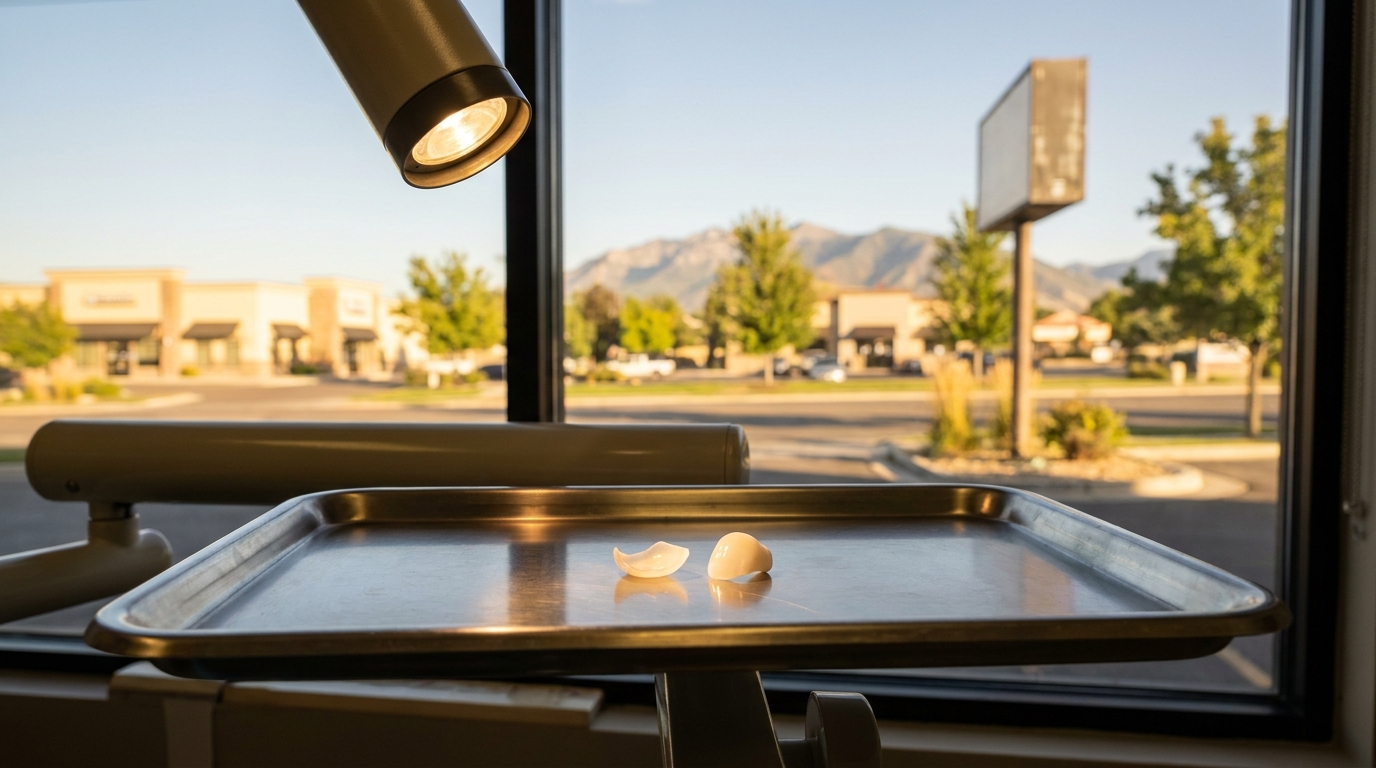
Here's the short answer. No-prep veneers (like Lumineers) are ultra-thin porcelain shells — about 0.2–0.3 mm — bonded to your teeth with little or no drilling. Traditional porcelain veneers are thicker, roughly 0.5–0.7 mm, and require permanent enamel reduction of 0.3–1.0 mm. No-prep is best for small, lightly discolored teeth. Traditional wins when you want major shade or shape changes.
Now let's pop the hood.
What actually makes no-prep veneers different from traditional porcelain veneers?
The difference is thickness and what has to happen to your enamel. No-prep veneers are about 0.2–0.3 mm — often called "contact lens thin" — and bond onto enamel with minimal or no drilling. Traditional porcelain veneers are 0.5–0.7 mm thick and require your dentist to shave 0.3–1.0 mm of enamel first. That single choice drives everything else: reversibility, esthetics, sensitivity, and price.
No-prep veneers — Lumineers being the most recognized brand — are made from a proprietary Cerinate porcelain by DenMat. Because so little enamel is touched, they're often described as semi-reversible.
Traditional veneers use materials like lithium disilicate (e.max) or feldspathic porcelain. That extra thickness is real estate for the ceramist. More room means more control over color, shape, and light behavior — but you can't undo the prep.
At Luca Aesthetic in Woods Cross, both approaches are on the table. The right one depends on your teeth, not your Pinterest board.
Which veneers are better for your smile — no-prep or traditional?
Neither is universally "better." No-prep veneers win when your teeth are naturally small, slightly recessed, worn, or only lightly discolored. Traditional porcelain veneers win when you want dramatic color change, need to cover dark stains or old bonding, or want to reshape crowded, chipped, or larger teeth without looking bulky. The candidacy test comes before the cosmetic dream.
You're likely a strong no-prep candidate if…
- Your teeth are small, worn, or slightly tucked behind your smile line.
- Discoloration is mild — think a couple of shades brighter, not a full transformation from gray to white.
- You have healthy enamel you want to keep intact.
- You want a process with no drilling and typically no anesthesia.
Traditional porcelain veneers are the smarter call if…
- Your teeth are dark, tetracycline-stained, or heavily restored.
- You want significant shape changes — longer edges, closed gaps, reshaped contours.
- Your teeth are already full-sized or slightly protrusive (adding thickness without prep can look bulky).
- You're planning a comprehensive smile makeover across 8–10 upper teeth.
How does the mechanism actually work — from prep to bond?
The under-the-hood sequence differs in one key stage: enamel reduction. No-prep veneers skip it, so the tooth stays essentially untouched, an impression or scan is taken, ultra-thin shells are fabricated, and they're bonded directly to enamel. Traditional veneers add a controlled reduction step of 0.3–1.0 mm, temporaries during lab fabrication, and a final bond onto the prepared surface.
Why the prep matters mechanically: bonded porcelain performs best against enamel, not dentin. Aggressive reduction that exposes dentin weakens the bond and raises sensitivity risk. That's why modern cosmetic dentistry — the approach practices like Luca Aesthetic in the Bountiful–Woods Cross corridor lean into — treats enamel like a finite resource. You only get to remove it once.
There's data behind this bias, too. A prospective NIH-published study followed 186 veneers over about nine years — 84 conventional and 102 no-prep or minimally invasive — and found higher survival rates for the no-prep and minimally invasive group. Preserving enamel isn't just philosophy. It correlates with longer service life.
What do veneers cost in Woods Cross, UT in 2026?
Expect roughly $800–$1,500 per tooth for no-prep veneers and Lumineers, and roughly $925–$2,500 per tooth for traditional porcelain veneers in the Woods Cross and greater Salt Lake metro market. Utah-focused cost aggregators consistently place no-prep at the lower end, with traditional veneers averaging slightly higher due to material choice, prep time, and lab work. Premium cosmetic cases can reach the top of that range.
| Feature | No-Prep Veneers (Lumineers) | Traditional Porcelain Veneers |
|---|---|---|
| Thickness | 0.2–0.3 mm | 0.5–0.7 mm |
| Enamel removed | Minimal to none | 0.3–1.0 mm |
| Reversible? | Often semi-reversible | No — permanent |
| Anesthesia typically needed? | Usually no | Often yes |
| Best for | Small, worn, lightly discolored teeth | Dark, chipped, or restored teeth |
| Color masking | Limited | Strong |
| Typical lifespan | 10–15 years | 10–20 years |
| Utah price per tooth | $800–$1,500 | $925–$2,500 |
Cost drivers within each category include material tier (standard porcelain vs premium e.max or hand-layered feldspathic), case complexity, and the experience of the dentist and lab. A 10-tooth smile design with a top cosmetic ceramist behaves very differently, financially, than two front teeth.
Why does the Woods Cross setting matter for this decision?
Two things about living along the Wasatch Front actually shape veneer planning: dry high-desert air and hard water. Utah's low humidity can amplify tooth sensitivity after prep, and the mineral content in local water contributes to surface staining over time. Both nudge many Woods Cross patients toward preserving enamel where possible and choosing porcelain (which resists staining) over composite alternatives.
Woods Cross also sits in the Davis County corridor between Bountiful and Salt Lake City — a market with dozens of general and cosmetic dental practices. That competitive density is good for patients: consultation quality, digital smile design, and transparent case-specific quoting have become table stakes rather than premium add-ons.
Luca Aesthetic operates in this corridor and holds a 4.9★ rating across 477 Google reviews, with recurring themes around thorough consultations and transparent communication — the exact inputs a veneer decision depends on. One recent reviewer described "an exceptional experience from beginning to end," citing precision and attention to detail. That's the kind of process discipline that separates a good veneer outcome from a regretted one.
What are the real tradeoffs nobody explains upfront?
The honest tradeoffs come down to control versus preservation. No-prep veneers preserve your enamel and keep options open, but they give the ceramist less room to correct color and shape — meaning bulkier results on already full-sized teeth and limited masking on dark ones. Traditional veneers deliver maximum esthetic control and shade change, but the enamel reduction is permanent, and you're committed to veneers or crowns on those teeth forever.
The other under-discussed reality: even Lumineers cases sometimes need light enamel reshaping to avoid a "chiclet" look. A true no-prep candidate is a specific anatomical profile, not a marketing category. A careful consultation — photos, scans, and often a digital mock-up — should tell you which one you actually are before any drill or bond touches your teeth.
Frequently Asked Questions
Are Lumineers the same thing as no-prep veneers?
Lumineers are a specific brand of no-prep veneer made by DenMat from proprietary Cerinate porcelain, roughly 0.2–0.3 mm thick. "No-prep veneers" is the broader category — Lumineers is one product within it. Other no-prep and minimal-prep options exist using different ultra-thin ceramics. The clinical principles (minimal enamel removal, often reversible, limited color masking) apply across the category.
Do no-prep veneers really require zero drilling?
In ideal candidates, yes — no drilling and no anesthesia. In reality, many cases benefit from light enamel reshaping to prevent a bulky or overly convex result, especially on larger or protrusive teeth. That reshaping is still far less than traditional prep, and enamel is largely preserved. Your dentist should tell you upfront whether your case is truly no-prep or minimal-prep.
How long do porcelain veneers last?
Traditional porcelain veneers commonly last 10–20 years with good care. No-prep veneers and Lumineers typically last 10–15 years in real-world conditions, though the manufacturer cites up to 20. Longevity depends on bite forces, nighttime grinding, oral hygiene, and whether the veneers are bonded to enamel rather than dentin. Nightguards significantly extend service life for grinders.
Can no-prep veneers be removed later?
Often, yes. Because little or no enamel is removed, no-prep veneers are frequently described as semi-reversible — they can sometimes be taken off without permanent structural damage to the tooth underneath. Traditional porcelain veneers cannot be reversed; the enamel reduction is permanent, so those teeth will always need veneers or crowns going forward.
Do veneers cause tooth sensitivity?
Traditional porcelain veneers can cause mild, usually temporary sensitivity because enamel is removed and dentin sits closer to the veneer's inner surface. No-prep veneers typically cause little to no sensitivity since enamel stays intact. Utah's dry climate can slightly amplify post-prep sensitivity for some patients, which is one reason enamel-preserving approaches appeal to many Woods Cross patients.
How do I know which veneers are right for me?
A full cosmetic consultation is the only reliable answer. Your dentist should evaluate tooth size, color, enamel thickness, bite, and smile goals, then walk you through candidacy for each option — often with photos or a digital mock-up. If a provider recommends one type without examining these factors, get a second opinion before committing to permanent enamel reduction.
The bottom line for Woods Cross smiles
No-prep veneers and traditional porcelain veneers aren't rivals — they're different tools for different smiles. If your teeth are small, lightly discolored, and structurally healthy, a no-prep or minimally invasive approach in the $800–$1,500 range preserves enamel and keeps future options open. If you want a dramatic transformation across multiple teeth, traditional porcelain in the $925–$2,500 range gives your dentist the control to actually deliver it.
The decision worth protecting is your enamel — because you only get to make it once. Readers in Woods Cross, UT who want a thorough, honest evaluation of both options can reach Luca Aesthetic at lucaaesthetic.com to start with a consultation and a case-specific plan.